Double Ferrule Compression Fittings: Leak-Free Instrumentation Connections
, by Surplus Warehouse, 5 min reading time
, by Surplus Warehouse, 5 min reading time
A complete guide to double-ferrule compression fittings, tube preparation, assembly, selection, inspection, and leak prevention.
Double-ferrule compression fittings join metal tubing without welding, flaring, or cutting pipe threads into the tube. When the fitting, tubing, and installation procedure are correctly matched, the two-ferrule design produces a secure connection for instrumentation, sampling, control, process, and hydraulic service.
This guide explains how the fitting grips and seals, why tube preparation matters, where this connection style is commonly used, and what to inspect before putting a system into service.
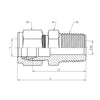
A typical assembly has four working pieces: the fitting body, a front ferrule, a back ferrule, and a nut. The tube slides through the nut and ferrules until it rests fully against the shoulder inside the body. Tightening the nut moves the ferrules forward in a controlled sequence.
The ferrules do not work like a simple washer. Their shapes are designed to move and deform in specific ways during installation. Substituting pieces from a different fitting system can change the sealing and gripping action even when the parts appear to fit.
A fitting cannot compensate for damaged, deeply scratched, out-of-round, or incorrectly sized tubing. The seal depends on the condition and dimensions of the tube surface where the ferrules set.
Double-ferrule fittings are often found in instrument-air lines, process measurement, pressure gauges, sampling systems, laboratory equipment, control panels, test stands, lubrication circuits, and compact hydraulic assemblies. Suitability always depends on the exact fitting material, tube specification, pressure, temperature, fluid, vibration, and service environment.
Choose the fitting and tubing as a system. Stainless-steel fittings are commonly paired with suitable stainless tubing for corrosion resistance, while other materials may be used for different fluids and environments. The correct material cannot be chosen from pressure alone; chemical compatibility, external corrosion, temperature, and cleaning requirements also matter.
Verify all of the following before assembly:
Do not mix metric and fractional-inch tube sizes. They may be close enough to start into a fitting while still being unsafe or impossible to seal correctly. Do not assume components from different product families are interchangeable.
Use a cutting method appropriate for the tubing. An angled cut can keep the tube from seating fully against the shoulder and can leave uneven support at the ferrules.
Remove inside and outside burrs without creating a large chamfer or damaging the sealing surface. Clear away chips, oil contamination, and abrasive residue. Never let debris fall into a clean system.
Look for scratches, dents, flattening, corrosion, paint, or weld seam irregularities where the ferrules will set. Replace unsuitable tubing instead of relying on extra tightening.
Push the tube straight into the fitting until it reaches the internal shoulder. Hold it in that position while bringing the nut to the correct starting point.
Follow the instructions for that fitting family and tube size. Required turns can vary, and small sizes may use a different procedure. Guessing, mixing instructions, or tightening until the nut merely “feels tight” can produce an under-set or damaged assembly.
Align the run so the fitting is not forced to correct a bent or misaligned tube. Add appropriate clamps or supports so machine vibration and tube weight are not concentrated at the connection.
Most connection problems trace back to preparation, component mismatch, incomplete tube insertion, incorrect tightening, contamination, or movement in the tubing. If a connection leaks, depressurize the system safely before inspection. Do not tighten a pressurized fitting.
Look for a damaged tube surface, wrong tube size, backward or missing ferrules, mixed components, inadequate support, or a fitting body that has been overtightened. Replacing only one visible part may not correct damage elsewhere in the assembly.
Identify both ends of the connection, the tube outside diameter, material, thread standard, required orientation, and service conditions. Product photos are useful for recognition, but the written dimensions and specifications determine whether a fitting belongs in the system.
Browse double-ferrule instrumentation fittings or use the site search to find a specific configuration.